
Two's company, three's a crowd. It could be a grasshopper's motto. Grasshoppers are solitary inoffensive creatures, that go about their business hopping from here to there nibbling away at grass, seed, leaves, flowers and stems. There are parts of the world, however, when meteorological conditions favour massive reproduction - such as wet weather after a period of drought, and the sudden growth of greenery - and grasshoppers will begin to aggregate, creating at the same time a fertile playground for multiplication. A grasshopper that aggregates is called a locust. There is no taxonomical difference between the two, just a shift in the grasshopper's behaviour and morphology. A band of locusts will grow into a swarm which can become a plague where billions of locusts migrate together landing on crops that they will devour, before moving onto the next. Besides rain after drought, what could prompt a solitary grasshopper to become gregarious? The answer is 4-vinylanisole, or 4VA, a pheromone that is released by locusts and seduces other locusts. 4VA becomes active - although it would be more apt to say attractive - by binding to a protein receptor on the locust's antennae. The olfactory receptor 35, or OR35.
Not all grasshoppers aggregate to form swarms. Various species of the so-called short-horned grasshoppers have a swarming phase. This may happen when a period of drought followed by wet weather and a swift growth of vegetation occurs. The circumstances are then ideal for reproduction. Consequently, solitary grasshoppers will begin to approach their mates, to breed. This will create the formation of bands, which are gatherings of wingless nymphs that later become swarms of winged adults. Besides ground for breeding, the formation of swarms is also a way to guarantee survival. The more the better. As one swarm travels, or migrates, it may bump into another and merge into it, thus creating a larger swarm and, in the long run, perhaps even a plague. This seems to have been going on for some time too, since archaeological evidence suggests that locust migrations were already occurring 30 million years ago.
A large swarm may consist of billions of locusts, creating an undefined cloud that can spread over an area as large as thousands of square kilometres. That is about 80 million creatures per square kilometre - and desert locusts can travel up to 150km a day. Such swarms are an obvious threat to agriculture as they migrate from crop to crop, causing devastation in their wake. Not only do they kill plantations, but the probability of subsequent flooding is increased as huge areas of soil become bare.
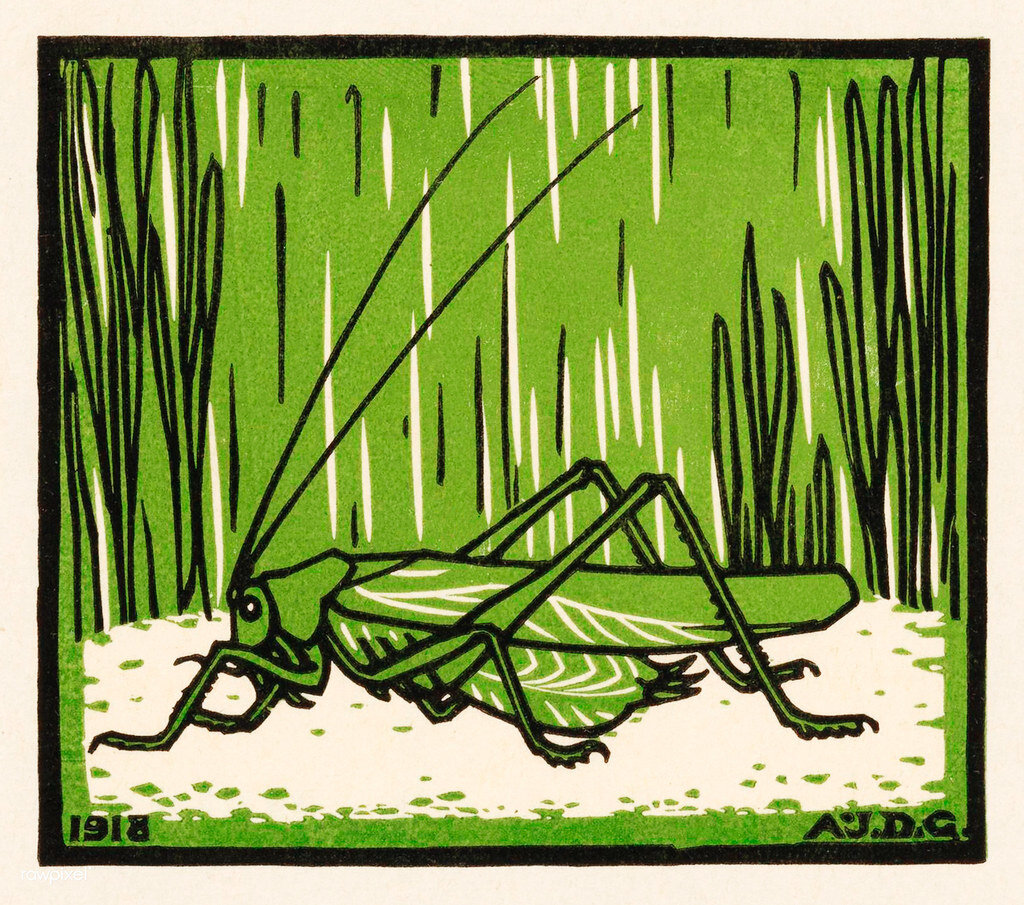
by Julie de Graag (1877-1924)
A swarm of locusts has its own dynamics too. It takes far longer for a swarm to form than it does for it to disintegrate for instance - and locusts that drop out of a swarm are rapidly sucked back in. How? The same way a swarm initially forms, by way of the pheromone 4-vinylanisole, or 4VA. Though 4VA is found in almost all tissues of a locust, the pheromone is primarily released from the locust's hind legs when it rubs them together but also, and just as importantly, when it is socialising. 4VA prompts grasshopper socialisation which, in turn, prompts the formation of 4VA. Aggregation via pheromones is not infrequent among insects. Ants are a well-known example, although the society they form is infinitely more organised than the sort of tamed chaos created by locusts, whose sole organisation seems to be the rough outline of a swarm.
How exactly 4VA attracts one locust to another at the molecular level remains a mystery. What we do know, however, is that its receptor is an olfactory receptor: the 4-vinylanisole receptor, or OR35. OR35 is located on the locust's antennae, in cone-shaped sensory organs known as the basiconic sensilla. When 4VA binds to OR35, the receptor tunes 4VA to become attractive and thus prompt aggregation - much in the way you'd spray on some perfume before a party to ease socialisation.
More intriguing, perhaps, is where 4VA comes from in the first place. How and why is it only synthesized when grasshoppers are aggregating? It's a sort of chicken-and-egg dilemma. It all begins with phenylalanine, an amino acid which is hugely present in plants. By way of a couple of plant enzymes, L-phenylalanine is converted to cinnamic acid which is then converted to p-hydroxycinnamic acid (pHCA). Locusts take advantage of this since they need pHCA to make the pheromone 4VA. So, by feeding off plants, locusts simply harvest pHCA from which they make 4-vinylphenol, or 4VP. 4VP is then methylated by either one of two of the locusts' methyltransferases, 4VPMT1 or 4VPMT2, to produce 4VA, which is volatile. The more 4VA is produced, the more locusts are coaxed to aggregate. And the more locusts aggregate (and eat), the more 4VA is produced.
It is easy to see how swarms can rapidly become plagues. Unless they are hindered. Over time, human populations have learned how to monitor the formation of large swarms by cultivating the soil where locust eggs are laid, or by collecting nymphs with nets, killing them with flamethrowers or even crushing them by mechanical means. This has helped and, in the past century, plagues have been few and far between. Naturally insecticides have also been widely used but, as always, they have had to be banned because of their persistence in the environment and their presence in the food chain. All sorts of systems have been tried out. Now, with the molecular knowledge scientists have acquired on 4VA synthesis, other ways of hampering with the formation of locust swarms are emerging. Synthetic 4VA pheromones could be used to attract locusts into traps for example. The two methyltransferases, 4VPRMT1 and 4VPRMT2, are also choice targets. If scientists were able to find an effective inhibitor of both methyltransferases, 4VA synthesis would not be possible - and locust aggregation would not occur.
Populations have suffered from crop devastation and famine due to plagues of locusts for millennia. Locusts were carved on Ancient Egyptian tombs that date back almost 3000 years BC. Today, plagues are less frequent thanks to knowledge in swarm regulation. Despite this, a desert locust plague that spread over Africa, the Middle East and Asia lasted an astounding three years in the 1960s, with 30 billion creatures covering an area as big as the city of Istanbul in Turkey. Perhaps, soon, thanks to a greater knowledge of 4VA and its methyltransferases, scientists will find a way to halt the formation of swarms altogether.