
Sunday mornings are spent reading the news. Sometimes they're spent catching up on news. This is how, last weekend, I was sorry to learn - and so late - that the British zoologist and ethologist Desmond Morris had died. When I was young in the UK, Desmond Morris was huge. I had found his popular science books, in particular 'The Naked Ape' inspiring when I read them already twenty years after their original publication. There's a lot I wouldn't subscribe to anymore, but it was thanks to Morris that it really dawned on me that humans are animals too. We're equipped with things that have made us fundamentally different but, all in all, the way we are made follows the same guidelines as that of any animal. In the same pile of newspapers, I also read about psilocybin, the psychedelic produced by the mushroom P.semilanceata and how it seems to cause architectural changes in the brain. Still immersed in thoughts about Desmond Morris, his art immediately sprung to mind. For, yes, he was a respected surrealist artist too, and his paintings have always reminded me, in a strange sort of way, of the cellular world. The research the magic mushroom article was referring to describes a receptor psilocybin binds to in our brain, and the anatomical effects it is said to have had on several individuals. The psychedelic binds to a receptor known as 5-HT2AR, to which serotonin usually binds.
Psilocybin - its nature, how it was found, when it was found, what it does, its synthesis and how it became popular for artists and researchers alike in the 1960s - has already been discussed in a previous issue: When the mind bends (PS issue 198). Because of its hallucinogenic outcomes, the psychedelic (literally meaning 'what the mind shows') swiftly became illegal, making it difficult for scientists to pursue their research on a compound that had already proved beneficial to patients dealing with depression. Despite this, and persistent administrative hurdles, scientists have continued to observe psychedelics and what they do to the human brain in the hope of finding ways to alleviate psychiatric disorders, including alcohol and nicotine dependence. One of the best ways to understand their effects is to study the brain receptors they bind to, which turned out to be serotonin receptors.
Both a neurotransmitter and a hormone, serotonin - like its receptors - is not only present in the brain (which houses 10% of the body's serotonin) but also throughout the body (90% of which is found in the gastrointestinal tract), suggesting it is involved in essential body functions. And it has been doing so for a long time since serotonin receptors have been around for at least 800 million years. First discovered in the 1930s, serotonin is a type of tryptamine (5-hydroxytryptamine or 5-HT) initially believed to be part of only gastrointestinal and cardiovascular functions. However, over the years and with the advancement of technology, serotonin receptors have been gradually characterised as has been the extent of their involvement in numerous biological processes, which are as varied as mood regulation, sleep cycles, digestion, wound healing, bone metabolism and even sexual desire.
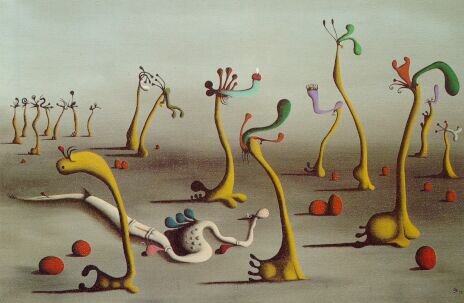
by Desmond Morris (1928-2026)
used with permission for PS issue 236
Serotonin binds to 5-HT receptors. There are 7 distinct families of 5-HT receptors (5-HT1-7), 6 of which are G-protein-coupled receptors (GPCRs), and 14 different subtypes. GPCRs are cell-surface receptors that pass through the cell membrane seven times (seven transmembrane helices), forming an extracellular domain and an intracellular domain. The extracellular domain welcomes the ligand which squeezes into a binding pocket usually deeply embedded in the cell membrane. The intracellular domain of GPCRs is coupled to a G protein. When ligands bind to their receptors, this causes a conformational change in the GPCR thus passing the signal on to trigger off specific pathways.
Brain serotonin binds primarily to 5-HT2A receptors, which are G-protein-coupled receptors largely present in the cortex where they play a key role in cortical function and cognition. When serotonin lodges itself in the binding pocket of 5-HT2A, two of the seven transmembrane helices (helices 5 & 6) shift considerably outwards, while one (helix 7) shifts slightly inward. This overall movement translates into a signal which is then transmitted downstream. Two kinds of 'non-natural' molecules can take a ligand's place. These are called agonists, and antagonists. Agonists will simply pretend they're the ligand - say serotonin - and make sure the shift between helices 5 & 6 and of helix 7 is stabilised. Antagonists, however, will also pretend they're serotonin but instead of stabilising the shifts they'll prevent them from occurring - sometimes by even inducing receptor internalisation - thus preventing 5-HT2A activity.
Psilocybin is a naturally-occurring tryptamine (4-phosphoryloxy-N,N-dimethyltryptamine) produced by over 200 species of mushrooms. Biologically inactive, it is rapidly dephosphorylated once in the body to become the active drug psilocin - a potent serotonin agonist. If psilocin can ease itself into the binding pocket of 5-HT2A like serotonin, why does it not spark off the same downstream pathways as the ligand it has replaced? Instead, it causes hallucinogenic effects by altering our perception, mood and cognitive processes. Why? Because, although psilocin is similar to serotonin in structure, it doesn't fit in the receptor's binding pocket in the same way. Consequently, it affects the helical shifts and, thus, the receptor's activity differently. Namely, whereas serotonin maintains an overall balance across existing neural networks, psilocin disrupts them by causing a spike in the release of key neurotransmitters such as dopamine and glutamate - both critical chemical messengers involved in how we think, feel and move.
The psychedelic experience of psilocybin shifts consciousness profoundly. Users go through important changes in sensory perception, emotional processing and the sense of self. Colours become richer, and sounds become more resonant as they are accompanied by visual and auditory hallucinations. Time perception is also drastically distorted. Once the effects have eroded, many users experience an afterglow with a heightened sense of clarity and well-being, as well as an improved mood. This is what seduces scientists.
To date, drug development has really been centred on the use of antagonists to alleviate psychiatric disorders. Why not turn to agonists, such as psilocin? Indeed, psilocybin does seem to promote dendritic remodelling and synaptic pruning, i.e. it shapes the brain differently, which must have an effect on cognition. One recent study was carried out on several healthy individuals who had never touched psilocybin. A strong dose was given to each (25mg). All of them still experienced a sense of well-being, for instance, one month after the experiment. The researchers observed a long-term change of white matter fibres in the cortex, which may explain this, although they remain cautious - minds are so profoundly unique, subjective in the real sense of the word, and so influenced by the environment and an individual's (subconscious) response to it. Despite this, agonist drug development is currently intense. Perhaps, in the not so distant future, it will be possible to design specific ligands for 5-HT2A receptors so fine-tuned - and perhaps even customised - that they could 'normalise' brain disorders while avoiding undesirable side-effects.