
We have all seen animals tend to their young ones. How a female keeps them close to her warm body, how a gentle paw will push a pup or a kitten towards a teat. By extension, animals who grow up together and become part of a pride, a flock or a clan will protect their members from the potential hostility of another pride, flock or clan. Empathy. Instinct. Altruism. Care. Bonding. These are qualities that belong to all animals. Humans included, of course. Naturally, all depends on the surroundings and the cues. As humans, we like to think that these qualities are part of us, part of our personality, and that we decide when to 'feel' them. To a certain extent we do. However, without the help of a protein known as oxytocin, there is growing evidence that we would lack these qualities altogether, which is a disturbing thought. The fascinating part of this tiny protein seems to be to ensure that the reproductive process - from mating to birth and postpartum care - is a success. Thus guaranteeing the survival of the species.
How was a peptide such as oxytocin discovered? How did scientists stumble upon the vast realm of bioactive compounds? Since the ancient times and until the early 1800s, bioactive chemicals -that is to say chemicals that have an effect on a living organism - were sought in organisms outside animals, namely plants or fungi. Plant chemistry really began at the end of the 1700s with the isolation of bioactive chemical compounds such as morphine, for example, from the opium poppy Papaver somniferum. The quest for compounds already active within the human body occurred with the growing understanding of bioactive compounds synthesized by mammals themselves and the concomitant birth of endocrinology in the early 1900s.
The British pharmacologist and physiologist Sir Henry Dale is said to have identified the uterine-contracting properties of a principal in 1906, which he later named oxytocin from the Greek 'oxys' meaning 'swift' and 'tokos' meaning 'childbirth'. Oxytocin was located in the pituitary gland, a small gland found at the base of the brain, below the hypothalamus. Crude extracts were later shown to induce uterine contractions and milk ejection. In the early 1950s, with the rising of the first protein sequencing techniques, the American biochemist Vincent du Vigneaud determined that oxytocin was made up of only nine amino acids. In 1953, he managed to synthesize the hormone artificially and, in so doing, became the first scientist ever to synthesize a polypeptide hormone.
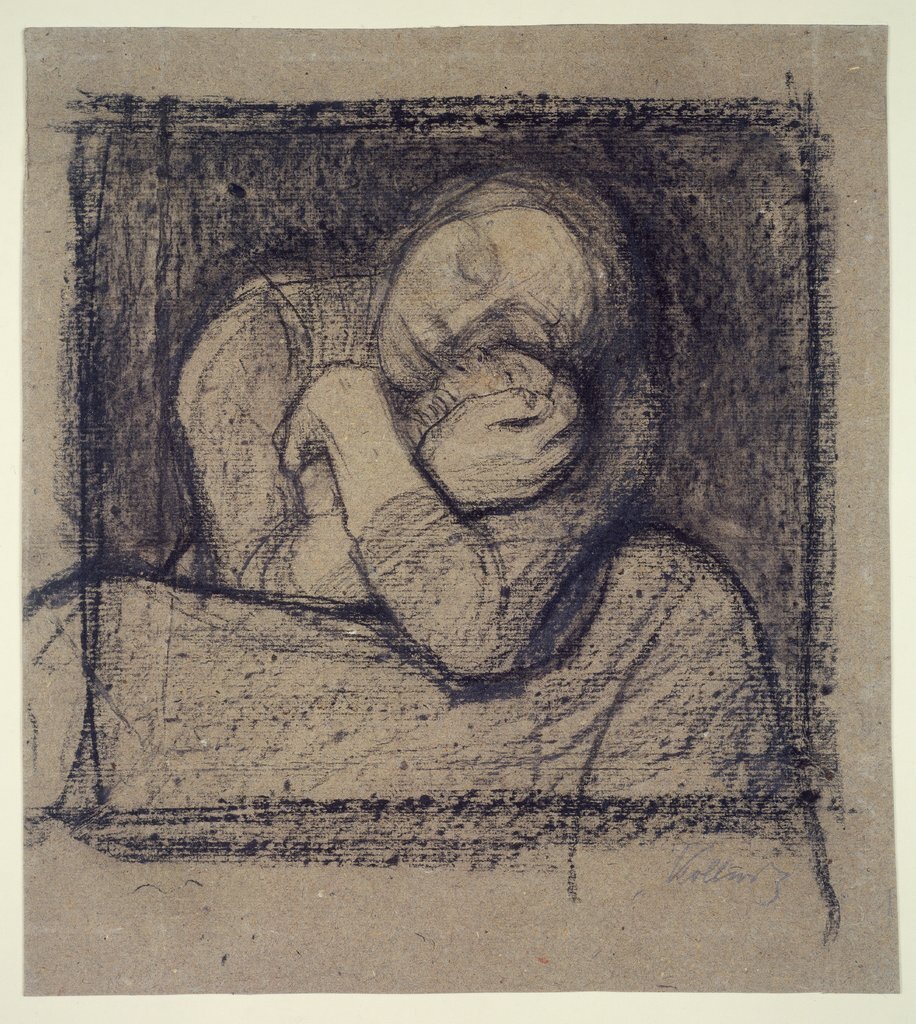
Käthe Kollwitz (1867-1945)
For a long time, oxytocin was known for its role as an inducer of uterine contractions during childbirth, and lactation after childbirth. But over the years, it became more and more obvious that this small peptide was involved in many more tasks, which is reflected in the widespread distribution of its receptors in an organism. Produced by brain cells in the hypothalamus, once synthesized, the peptide travels down the length of the neurons to the pituitary gland where it is stored. When required, it is secreted straight into the bloodstream where it targets organs as diverse as the kidney, the heart, the ovaries, the testis, the thymus, the vascular endothelium and the pancreas. Although things have not been fully established in humans, besides labour and lactation, the physiological functions resulting from such a wide propagation of oxytocin could also suggest roles in male and female fertility, cardiovascular control, appetite, pancreatic function, the immune system as well as bone and muscle formation.
Structurally, the nine amino acids composing oxytocin fold into what looks like a comma - or the digit 6 -depending on which way you look at it. The six N-terminal residues form a loop while the last three C-terminal residues jut out like a small tail. The overall ring-shape is stabilised by a disulphide bond formed by two cysteine residues at positions 1 and 6. The ring-like formation of oxytocin is buried in the upper third part of the receptor's pocket while the last three residues remain close to the extracellular space. The very last C-terminal residue (Gly9) is expected to be important for activation. Oxytocin receptor activation leads to diverse processes such as phosphorylation, an increase in intracellular calcium, the release of prostaglandin and the production of nitric oxide - all of which trigger off multiple downstream pathways.
It is hardly surprising, then, that oxytocin is involved in so many different physiological functions. A few examples. In animals, oxytocin is thought to govern the synchronisation of peak fertility with sexual receptivity - such as lordosis behaviour in females and penile erection in males - which is an ideal way of ensuring that something positive will come from mating. Once pregnancy occurs, the oxytocin receptors and the oxytocin-producing brain cells form a completely different circuit to promote yet other roles. In this way, during birth, the foetus will slowly make its way down the birth canal, stretching the surrounding tissues as it does. This provides a mechanical cue for the release of oxytocin which not only supports uterine contraction during labour but also relieves the mother from pain and stress by acting as an analgesic and anxiolytic, respectively. Once born, the infant will suckle its mother's nipples causing cell contraction and subsequent milk ejection while tactile cues and mutual gazes - from the father too - will help them bond.
The roles promoted by oxytocin, or those in which it is involved, are astonishing and somewhat disquieting. Here is a nine amino-acid peptide capable of making us, or any other animal, behave in certain ways - not only by 'telling' us when to mate and who to mate with but also by guiding us in the way we bond with others. However, if you give it some thought, what oxytocin is really doing is making sure that the global process of reproduction is successful. It's a fascinating concept. Oxytocin accompanies us in such a way that from the act of mating to birth and parental bonding, a newborn - and the mother - has the best chances of survival. In a far broader sense, the species will thrive.
Oxytocin is found across all placental mammals. In fact, it is probable that oxytocin, or its chemical homologues, is evolutionarily ancient. Homologues are known in birds, reptiles, amphibians and fish where, like for mammals, they are known to play vital roles in regulating social and reproductive demeanours such as bird song and egg-laying for instance. However, in mammals, oxytocin seems to have acquired many other roles. Perhaps the peptide homologues began by promoting social bonding and cohesion (which is also necessary for reproductive success) and, with time, its roles stretched to mating behaviours, labour, lactation and nursing in mammals. Perhaps. Certainly, oxytocin is essential and necessary for labour and lactation. Without it, uterine contraction and milk ejection both fail, and nothing takes its place.
Oxytocin is a wonderful example of how behaviour and physiology can co-evolve. Though an intriguing corollary has recently emerged. If this peptide can promote social bonding and cohesion, and hence a sense of trust and cooperation within members of a same group, then could it not also be engaged in recognising what is part of a group and what is not? By extension, could oxytocin stem feelings of envy or even hostility towards individuals who belong to another group? It seems an awful lot to put on the shoulders of such a small peptide. Yet one grasps the assumption. A couple of decades ago, oxytocin was dubbed a 'love drug'. Over the past years, research has shown that the peptide's role is far more subtle and richer than that. With social bonding as the guiding principle, oxytocin takes care of a group's offspring so that it can continue to exist.