
Friends are coming for dinner. You've used sunflower oil, peppers and zucchini to prepare the main dish, and decided to add cucumber and tomatoes to the salad. For dessert, there's an apple and pear pie, to which you've added a few almonds for taste. For many of us, none of these food items are really very special and we can enjoy them all year round. Yet, without honeybees, there's a chance they wouldn't be part of our menus at all. A large portion of our - balanced - diet depends on bees or, to be more precise, on the side-effects of their foraging. When bees hunt for nutrients, pollen sticks to them and they inadvertently pollinate the flowers they visit next. As a consequence, fruits develop and their seeds germinate to give new plants. It's a win-win situation. But it's a fragile one. When honeybee populations wane, the plants they feed off will find it difficult to reproduce. Since the 1990s, the varroa mite has been infesting honeybees persistently and at historically high levels. As a result, crops dwindle too. Pesticides? Not only have mites become resistant to them but many are harmful to the bees themselves. So scientists have turned to the treasure trove of venom peptides and discovered two spider venom peptides able to kill varroa mites specifically. Their names: Ht1a and Gg1a.
The act of pollination unites a pollen grain with a flower's stigma. That is what pollinators, like honeybees, do. Fertilization occurs when the genetic heritage held within the pollen grain is joined to that of the ovule lodged in the stigma, and a seed is produced. The great majority of plants depend on pollination. Without it, they can't reproduce. In other words, they need the assistance of something - an animal, wind or rain - in order to produce a seed. Most flowering plants (a staggering 90%!) are actually hermaphrodites, so they can self-fertilize and produce their own seeds. But self-breeding is not a healthy option. When pollinators transfer pollen from one flower to another, not only are they unwittingly helping to spread the plant geographically but they are also promoting genetic diversity. This makes the plant stronger in the face of disease or climate change for example.
Plants benefit from the mobility of animals. Although some plants climb up cliffs or meander their way across soil, they rarely go as far as animals can. Fossil evidence shows that insects had already been interacting with ancient seed plants three hundred millions years ago - that is two hundred million years before flowering plants appeared on earth. When they did, however, they caught on fast and adapted to their environment by releasing specific scents or wearing bright colours to seduce foragers. This ensured cross-pollination while providing their gentle predators with sustenance: sweet nectar for energy and pollen grains as filling nutrients. Wind and rain can also do the job, naturally. In fact, crops like wheat and rice rely only on wind while other plants have drains that fill with rain allowing pollen grains to float up and reach the flower's stigma.
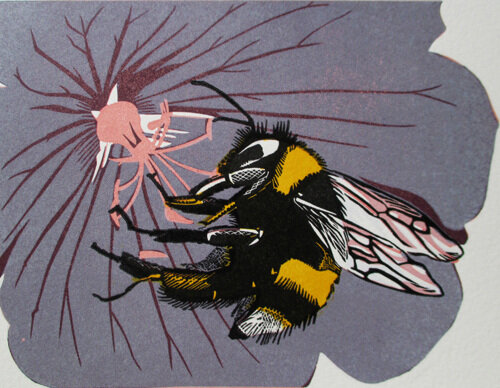
courtesy of the artist
We know a lot about cross-pollination today but, although poets, artists and philosophers have long depicted the beauty of insects and flowers, it was only in the 18th century that the penny dropped. The British botanist and gardener Philip Miller (1691-1771) was the first to hint the role of insects in plant reproduction. Aware of these observations, the politician and amateur botanist Arthur Dobbs (1689-1765) went on to write that '[...] Providence has appointed the bee to be very instrumental in promoting the increase of vegetables'. However, it took a few more years for two Germans, the botanist Joseph Gottlieb Kölreuter (1733-1806) and naturalist Christian Konrad Sprengel (1750-1816), to speak of plant sexuality and the role of insects in pollination. Charles Darwin (1809-1882) is said to have been inspired by their writings, taking plant reproduction to yet another level as he brought in the notions of adaptation and survival of the species.
Besides being vital for plants, pollination has also become vital for our global food economy. Agriculture massively depends on flowering plants, and pollination increases the quality and productivity of crops. So if pollination declines, the supplies of food that depends on it do too. Bees, especially honeybees, are among the most prominent of our agricultural pollinators. Since the 1990s, the number of bee species has dropped drastically, shrinking by 25% between 2006 and 2015 only. Why such a decline? The reasons are multiple and probably due to a combination of things: pathogens, climate change (due to global pollution), habitat destruction, invasive plant species, genetic mutations... Different types of pollution affect pollinators in an unexpected fashion too: air pollution can veil scents released by flowers while light pollution can disorientate.
Many insecticides kill bees too, while bee parasites themselves have become more resistant to pesticides. One honeybee parasite in particular is proving to be a major threat for honeybees: the Varroa destructor mite. The varroa mite feeds on honeybees by tucking itself under the overlapping plates of the bee's abdomen and using its legs to hold onto the bee's body, much in the way a tick holds onto ours. Most (85%) of the losses of honeybee colonies are caused by this one mite, which not only infests bees but is also a vector of bee viruses. Classical acaricides are proving to be useless as the varroa mite has acquired resistance to them. It so happens that spiders feed on arachnids such as Varroa destructor and their venoms are bulging with peptides that can kill them. So scientists turned their attention to the potent venoms of two spiders - the Tasmanian cave spider and the Giant Japanese funnel-web spider.
Since the 1950s, scientists have been fishing in pools of thousands of venom peptides seeking for those that could have a therapeutic potential. What if, this time, they found an arthropod venom peptide able to kill the honeybee varroa mite while proving to be harmless to the bees themselves and with no consequence to human health? All venoms are a cocktail of toxin peptides each of which are able to activate or deactivate specific molecular targets in a predator's victim. More often than not, venom toxins meddle with the prey's nervous system by disrupting essential metabolic pathways that cause temporary paralysis or even death. This makes them easier to eat. In this way, two peptides were discovered: µ-gradutoxin-Ht1a (or Ht1a) and u1-MATX-Gg1a (or Gg1a). Ht1a belongs to the venom of the Tasmanian spider and Gg1a to venom of the Japanese spider.
Venom peptides are modest in size. Gg1a is 34 amino acids long. Ht1a is three times longer with 127 amino acids. The molecular target of Gg1a is not known. Ht1a, however, attacks the mite's voltage-gated sodium channels - as do many spider venom peptides. Voltage-gated sodium channels are found primarily in the membranes of excitable cells like neurons, muscle fibres and heart muscle cells. If the channels are impeded, electrical signalling across cells is weakened and can ultimately cause death. Although Ht1a is just as effective against honeybee voltage-gated sodium channels as it is against those of mites in the laboratory, the peptide doesn't seem to affect honeybees. This may be due to an acquired resistance of Ht1a. On the other hand, since the pesticide was applied topically (in the laboratory), Ht1a may simply penetrate varroa mites more easily than it does honeybees. As for human voltage-gated sodium channels, Ht1a activity proved to be absent or weak. Although researchers still need to understand how Ht1a penetrates the mite's cuticle, anti-varroa toxins such as Ht1a could be applied topically by spraying the insides of beehives where it would be safe for the beekeepers and tolerated by the honeybees.
Varroa mites have thrived in the past years by taking advantage of the constant pressures we pile onto the dynamics of plant-pollinator interactions caused by our modern-day habits. Pollination declines have occurred more than once in the past. Even profound ones such as the Cretaceous-Paleogene mass extinction. Despite this, they did not cause a total collapse of pollination but actually brought about novel ecological networks. Plants and their pollinators have always been through cycles of disruption and survival, but they have shown astounding resilience thanks to an inbuilt adaptive flexibility. However, nowadays, human activity and its consequences on the environment may cause so much stress on pollination dynamics that we may reach a point where adaptation is not an option anymore. Who knows. What we do know is that scientists can not keep on turning to venom for solutions. We humans must also change our habits.